
On May 25, 1959, Time magazine devoted an article to the story of the Hungarian dancer Nicolas Darvas. The magazine had taken notice of him because of the extraordinary success of this stock market newcomer. Many Wall Street professionals of the day were shaken that his Darvas strategy disregarded almost all the then-common formulas for success in the market.
What was his secret?
He came to stock trading almost by accident, because he once received a package of shares instead of money for a performance. When he remembered the position a few months later, its value had nearly tripled.
With the roughly $9,000 this was now worth, his interest in this kind of business was awakened. He went on to study almost every book on the subject that he could get his hands on. Real success, however, did not come at first, not even when he consulted advice and tips from analysts.
With the insights from these experiences, he began to look for the characteristics of successful investments himself. Since stocks with strong growth drivers regularly take noticeable breathers before continuing their trend, he looked for features that would allow him to follow exactly these price movements.
His Darvas strategy
According to the rules, a stock should already have risen about 100% from its 52-week low. The pause in the price rise is identified by forming his famous Darvas box. For this, the stock should fail to make a new high for three days in a row. The high confirmed in this way forms the upper boundary of the box. A low subsequently confirmed in a similar way forms the lower boundary of the box, if no new low occurs in the following three days.
An entry occurs when the upper boundary of the box is broken. Darvas used a buy stop a few points above the boundary.
He placed a stop loss immediately after entering, a few points below the entry price. If the stock did not confirm the breakout with a significant rise, ideally with increasing volume, he consistently limited his losses with the tight stop loss and waited for the next opportunity.
In a more conservative approach, the stop can also be placed at the lower boundary of the most recent box. This way you can follow the profits without being stopped out too quickly.
A fundamental complement to the technical approach
Later he complemented the Darvas strategy with a fundamental approach. Since he recognized that the companies with the highest earnings growth rates are also interesting for well-capitalized investors, he wanted to be on board when prices rise in the wake of this capital. To do this he focused on the growth of revenue and earnings per share. Analysts' expectations for the future also play a role here.
In early bull markets and for stocks with strong trends, this strategy has lost none of its relevance.
The book on the Darvas strategy
Nicolas Darvas himself provides a detailed explanation in his book "How I Made $2,000,000 in the Stock Market". A German translation is available as well, titled "Wie ich 2.000.000 US-Dollar an der Börse verdient habe".
Applying the Darvas strategy on TradingView
With professional charting software such as TradingView, which can be used for free, a trading approach like the Darvas strategy can also be analyzed. It is possible to have the Darvas box drawn directly onto a chart and to derive the corresponding entries and exits from it.
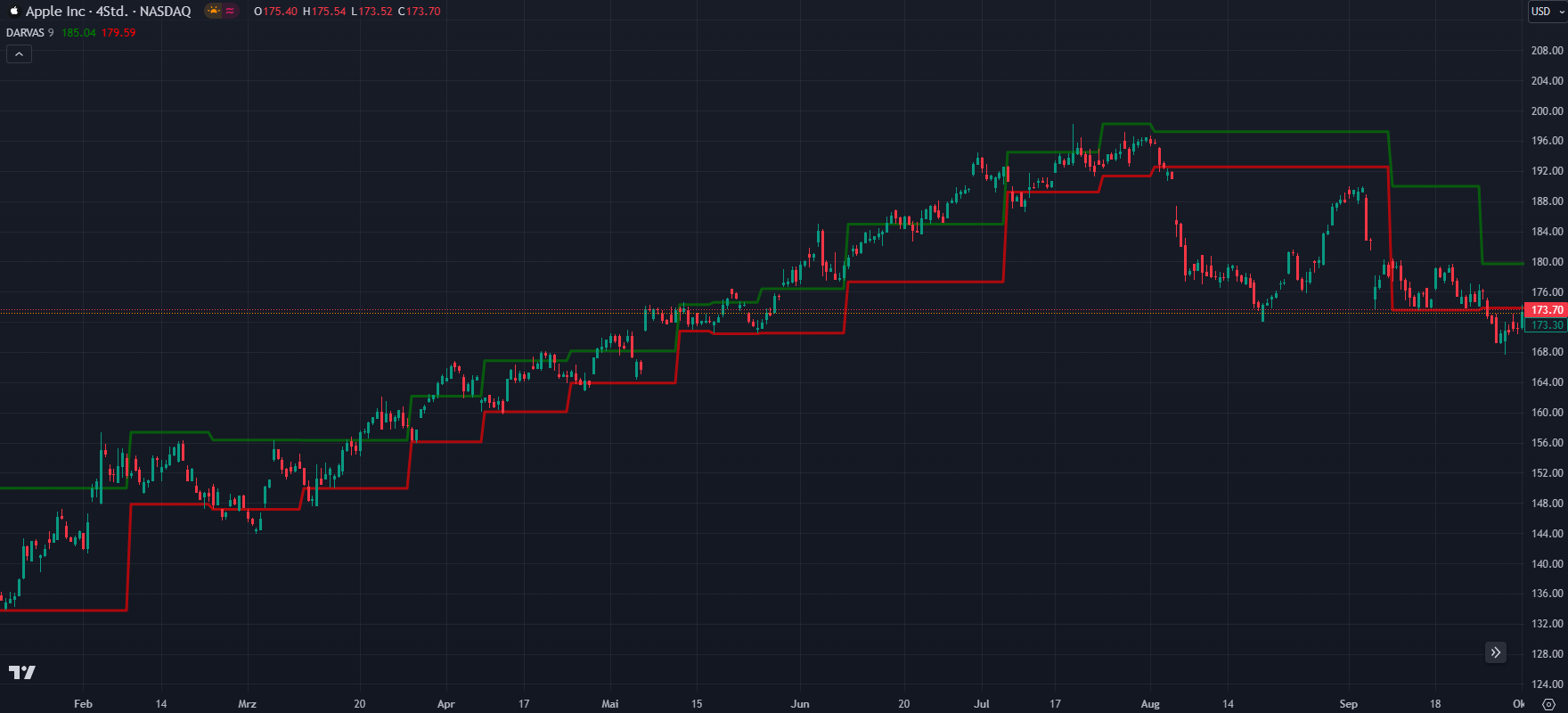
Open any chart, such as that of the Apple stock, and search for "Darvas" under "Indicators". A selection of scripts created by TradingView members appears. Depending on your choice, you can adjust the parameters and even have concrete buy and sell signals displayed.
If you would rather follow in the footsteps of the Hungarian dancer and stock market millionaire yourself, there are extensive drawing tools for the charts. With them you can place boxes in the chart yourself and even set alerts so you never miss a trade again.
Conclusion
By observing price movements and trend behavior, Nicolas Darvas developed a unique investment strategy whose rules still hold up in today's market situation. Thanks to his timeless trading approach, investors can still align their portfolio building with the Darvas method and act profitably in the market.
FAQs – Questions and answers
What is the Darvas strategy?
The Darvas strategy is a trading method developed by the dancer and investor Nicolas Darvas. It is based on identifying trend movements and using stop-loss orders to limit losses. Darvas developed this strategy after gaining personal experience in the stock market.
How does the Darvas strategy work?
The Darvas strategy involves identifying stocks that are reaching new highs and defining buy points as soon as they reach a certain level. Stop-loss orders are used to limit potential losses. Darvas also used the "Darvas box", a consolidation pattern, to identify potential entry points.
What role does the Darvas box play in this strategy?
The Darvas box is a consolidation pattern defined by a stock's price movement between certain price points. It helps to identify potential entry points for buying when the price breaks out of the box.
Is the Darvas strategy suitable for every investor?
The Darvas strategy requires a thorough understanding of the market and disciplined execution. Although it can be successful for some investors, it may not be suitable for everyone. It is important to consider your own knowledge, skills, and risk tolerance.
Are there examples of the successful application of the Darvas strategy?
Yes, there are numerous examples of investors who were successful with the Darvas strategy. Nicolas Darvas himself made considerable profits in the stock market, as did other traders who applied and adapted his method. However, keep in mind that past success is no guarantee of future profits.
This article is for information purposes only and does not constitute investment advice.